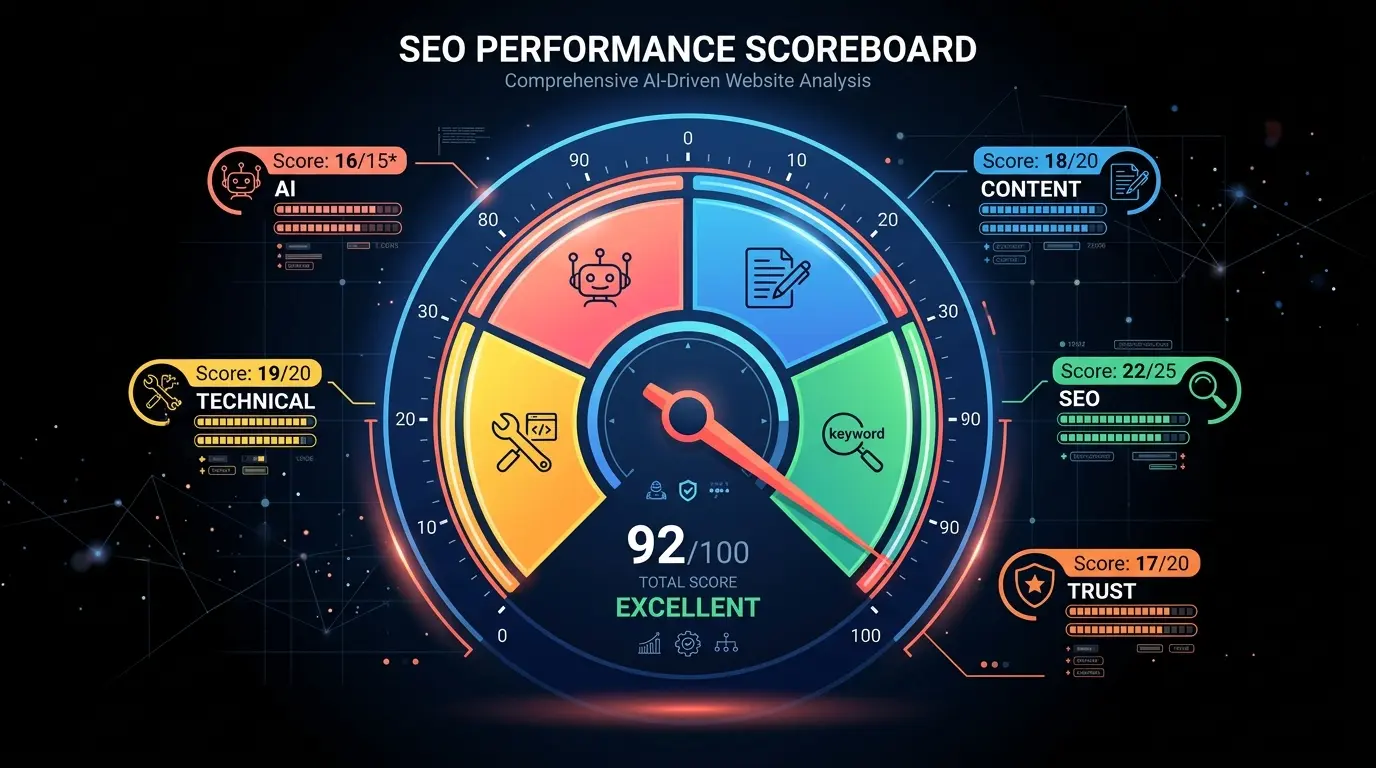
Every blog post Claude Blog generates gets a score from 0 to 100. That score is not a single number. It is the weighted sum of 5 categories, each measuring a different dimension of content quality. Understanding how scoring works helps you write better content, whether you use Claude Blog or not.
Run /blog analyze on any Markdown or HTML file to get your score. The analysis takes under 10 seconds and outputs category breakdowns, specific issues, and improvement recommendations. You can explore the full skill documentation at /skills/blog-analyze.
The 5 scoring categories
Each category has a fixed weight that determines its contribution to the final score. Here is the breakdown:
| Category | Weight | What it measures |
|---|---|---|
| Content Quality | 30% | Depth, accuracy, readability, structure, word count |
| SEO | 25% | Title tags, meta descriptions, headings, keywords, internal links |
| E-E-A-T | 15% | Experience, expertise, authoritativeness, trustworthiness |
| Technical | 15% | Schema markup, canonical URLs, OG tags, sitemap inclusion |
| AI Citation | 15% | Passage citability, structural readability, GEO readiness |
Content Quality (30%)
This is the heaviest category because content quality is the foundation everything else builds on. It evaluates:
- Word count: Does the article meet the target length for its template type?
- Heading structure: Clean H1 to H2 to H3 hierarchy with no skipped levels
- Paragraph length: Short paragraphs (2-4 sentences) for readability
- Readability score: Flesch-Kincaid grade level appropriate for the target audience
- Content depth: Presence of data, examples, statistics, and actionable advice
- Introduction quality: Does the opening paragraph clearly state what the reader will learn?
SEO (25%)
The SEO category checks whether your content follows on-page SEO best practices:
- Title tag: Under 60 characters, includes primary keyword
- Meta description: 120-160 characters, compelling and keyword-relevant
- H1 tag: Exactly one per page, includes primary keyword
- Keyword distribution: Natural placement in headings, first paragraph, and body
- Internal links: At least 2-3 links to related content
- External links: References to authoritative sources
- Image alt text: Descriptive alt attributes on all images
E-E-A-T (15%)
Google's E-E-A-T framework (Experience, Expertise, Authoritativeness, Trustworthiness) is critical for content credibility. The scoring checks:
- Author attribution: Named author with credentials or bio link
- Publication date: Visible date with datetime attribute
- Source citations: Claims backed by data, studies, or documentation
- Experience claims: Methodology, evidence, and results when the article genuinely reports first-hand work
- Trust signals: HTTPS, privacy policy link, contact information
Technical (15%)
Technical quality ensures your content is properly formatted for search engines and social platforms:
- Schema markup: BlogPosting or Article JSON-LD present and valid
- Canonical URL: Properly set to prevent duplicate content issues
- Open Graph tags: Title, description, image, and URL for social sharing
- Sitemap inclusion: URL present in sitemap.xml
- Mobile responsiveness: Content renders correctly on mobile viewports
AI Citation Readiness Heuristic (15%)
This internal editorial category reviews whether useful claims and entities are clear and supported. It is not a calibrated citation probability:
- Source fidelity: Claims accurately reflect suitable cited sources
- Factual support: Specific claims have evidence and unsupported testing claims are flagged
- Purpose fit: The article solves the reader's task without padding or page-factory patterns
- Structural clarity: Headings, lists, tables, and prose are used when they help the reader
- Entity clarity: Brand names, product names, and people clearly identified
Scoring bands
The 0-100 score maps to four quality bands:
| Score | Band | Meaning |
|---|---|---|
| 90-100 | Excellent | Publication-ready, exceeds standards |
| 80-89 | Good | Publication-ready, minor improvements possible |
| 60-79 | Needs Work | Targeted improvements required before publishing |
| 0-59 | Poor | Significant revision needed |
Scores describe alignment with the project's internal checks. They do not predict rankings, citations, traffic, or how many editing passes a draft needs.
Style signals are editing context
Burstiness, phrase patterns, punctuation, and type-token ratio can help identify repetitive or unclear prose. They cannot determine whether a person or model wrote the text, and they cannot block publication by themselves. Prose linting remains a transparent project style rule, not a Google requirement or AI detector.
How to improve each category
Here are targeted improvements for each scoring category:
- Content Quality: Add original analysis or evidence that serves the reader's actual task.
- SEO: Use descriptive titles, logical headings, contextual links, and crawlable primary content.
- E-E-A-T Signals: Cite suitable sources and document genuine experience claims with methodology and results.
- Technical: Set a canonical URL and keep metadata and structured data consistent with visible content.
- AI Readiness: Clarify entities and relationships, support factual claims, and remove low-value padding.