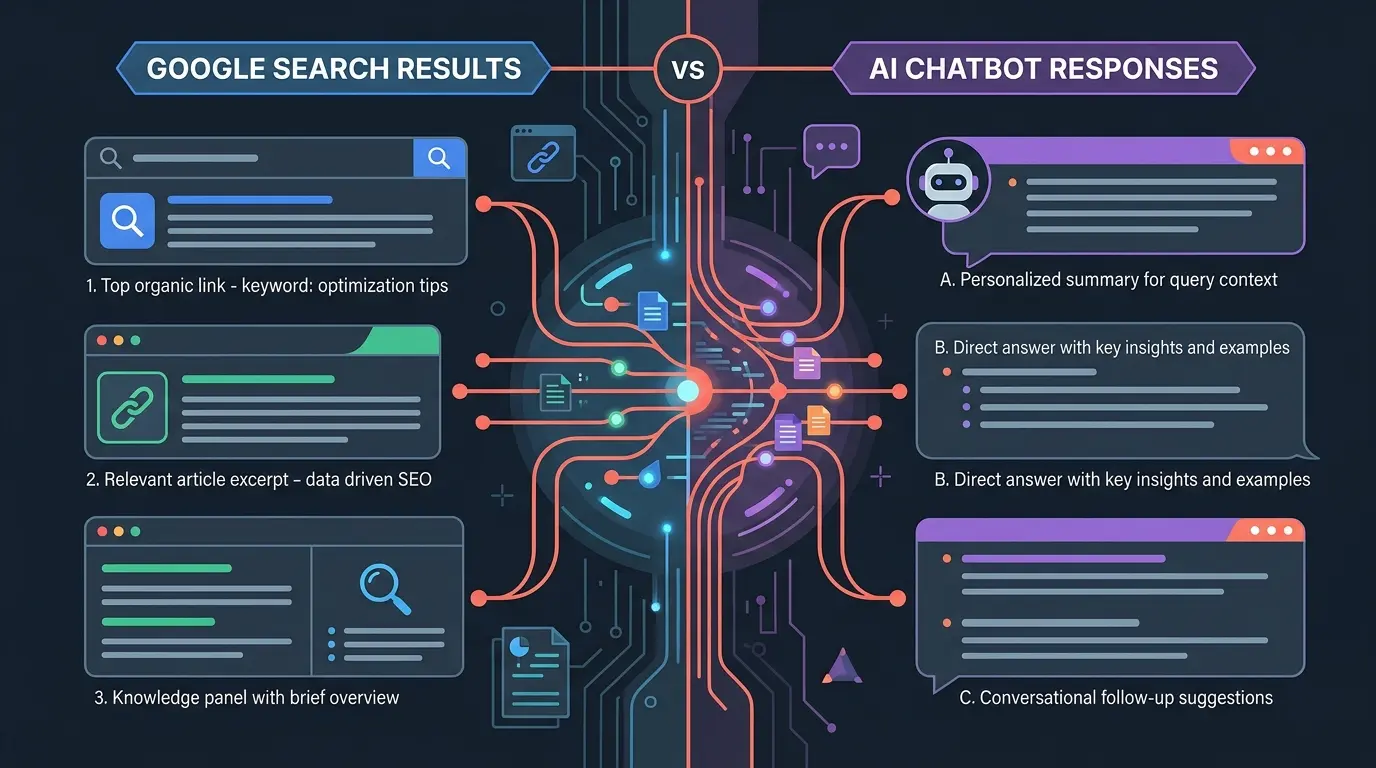
In 2026, there are two search systems competing for your readers. Google still processes 8.5 billion searches per day. But AI-powered search platforms, including Google's own AI Overviews, now reach billions of users monthly. Optimizing for one while ignoring the other means losing traffic from the other.
Dual optimization is the practice of writing content that ranks in traditional Google search and gets cited by AI platforms at the same time. The good news is that most of the structural qualities that earn AI citations also improve traditional SEO performance. You do not need two separate strategies. You need one strategy that serves both systems.
Traditional SEO vs generative engine optimization
Before building a dual strategy, it helps to understand what each system values differently:
| Factor | Traditional SEO | GEO (AI Citations) |
|---|---|---|
| Goal | Rank in top 10 blue links | Get quoted in AI answers |
| Key signal | Backlinks + relevance | Brand mentions + citability |
| Content format | Keyword-optimized pages | Self-contained answer passages |
| Authority | Domain Rating / PageRank | Entity presence across web |
| Technical | Crawlability + speed | AI crawler access + SSR |
| User intent | Click to visit page | Read answer without visiting |
The practical overlap is substantial: publish original, useful, well-supported content and keep it technically accessible. No fixed passage length, heading style, FAQ, or special AI schema guarantees selection.
The 5 pillars of dual optimization
These five pillars represent the structural elements that serve both traditional search and AI citation platforms simultaneously.
1. Stable, descriptive headings
Use headings that describe each section clearly and create stable anchors. A question is appropriate when the section answers a genuine reader question, but no question-heading quota applies.
2. Immediately useful key material
Place important material where readers can reach it without unnecessary interaction or padding. A short complete answer can stay short, while a complex subject can expand as evidence and intent require. Accordions are acceptable when key material remains accessible and the interaction does not hide essential content.
3. Structured data that feeds both
Schema markup helps Google understand your content and helps AI systems identify entities, authors, and publication dates. The key schema types for dual optimization:
- BlogPosting or Article: Headline, author, datePublished, wordCount
- FAQPage: Optional markup only when a visible FAQ genuinely helps readers
- BreadcrumbList: Site hierarchy for both Google breadcrumbs and AI context
- Person: Author entity with sameAs links to social profiles
Structured data helps machines understand eligible page details when it matches visible content and current documentation. It is not a ranking signal or an AI-citation shortcut. FAQPage earns no Google or AI-readiness points here.
4. Multi-platform authority
Traditional SEO relies heavily on backlinks. AI citation systems weigh brand mentions more heavily, especially on YouTube (correlation: 0.737), Reddit, and Wikipedia. For dual optimization, build authority on both fronts:
- Backlinks: Still matter for Google rankings. Pursue through content quality and outreach.
- YouTube presence: Create video content about your topics. YouTube mentions have the strongest correlation with AI citations.
- Reddit participation: Engage genuinely in relevant communities. Reddit is a top citation source for both ChatGPT and Perplexity.
- Author profiles: Maintain active LinkedIn and GitHub profiles linked via schema markup.
5. Technical access for all crawlers
Review robots directives for the services you intend to support. An /llms.txt file can provide optional context, but neither crawler access nor the file guarantees inclusion or citation.
Make primary content available in the rendered output and verify it with the relevant crawler and rendering tools. JavaScript-generated JSON-LD is acceptable to Google when it reaches the rendered DOM, matches visible content, and validates.
How Claude Blog handles dual optimization
Claude Blog's 4-agent pipeline is designed for dual optimization from the start. The Research Agent identifies both keyword targets (for SEO) and citability opportunities (for GEO). The Writing Agent structures content with question-based headings and self-contained answer blocks. The Optimization Agent checks both traditional SEO compliance and AI citation readiness.
Two commands make this concrete:
/blog write "topic"     # Generates dual-optimized content
/blog geo post.md       # Analyzes AI citation readiness
The /blog geo command, documented at /skills/blog-geo, produces platform-specific scores for Google AI Overviews, ChatGPT, Perplexity, and Bing Copilot. It identifies which passages are citable and which need restructuring.
For site-wide SEO analysis, Claude Blog integrates with Claude SEO, which provides technical audits, schema generation, and GEO readiness scoring at the domain level.
Practical example
Here is how dual optimization changes a single section:
Before (SEO only):
## Landing Page Best Practices

There are many factors that contribute to
a high-converting landing page. These include
clear CTAs, social proof, fast load times,
and mobile responsiveness.
After (dual-optimized):
## How do you optimize a landing page for conversions?

A high-converting landing page needs four elements:
a clear call-to-action above the fold, social proof
within the first scroll, page load time under 2.5
seconds, and a mobile-responsive layout. According
to Unbounce's 2025 conversion benchmark report,
landing pages with all four elements convert at
11.45% compared to 2.35% for pages missing two
or more.
The "after" version serves Google (keyword in heading, structured format, external citation), serves AI systems (question heading, self-contained answer, specific data point), and serves the reader (clear, actionable, evidence-backed).