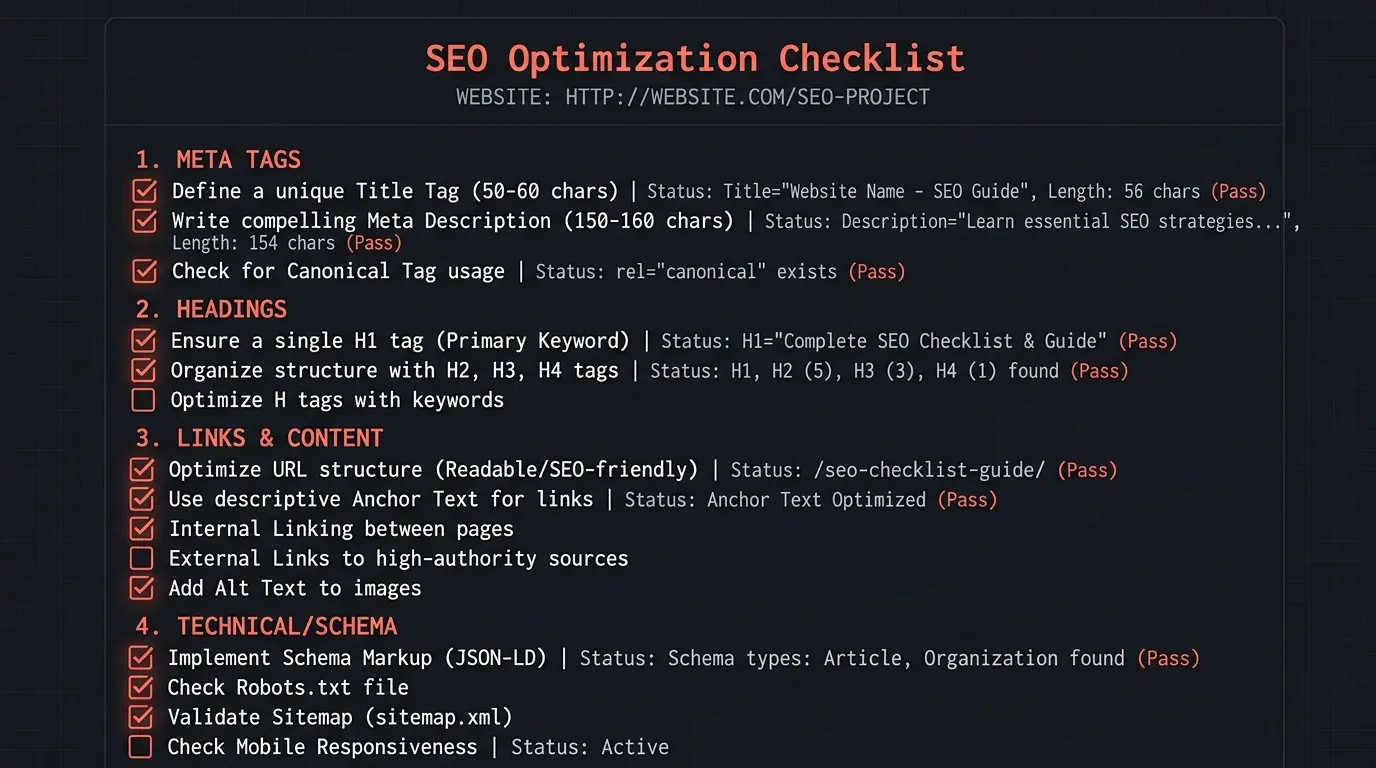
This checklist covers every SEO element your blog posts need in 2026. It is organized into four categories: on-page, technical, content, and AI citations. Use it before publishing every article, or run /blog seo-check to automate the entire process.
On-page SEO checklist
On-page elements are the foundation of blog SEO. These are the signals that tell search engines what your content is about and how to display it in results.
- Title tag under 60 characters. Include your primary keyword near the front. Make it compelling enough to earn clicks from the search results page.
- Meta description between 120-160 characters. Summarize the article's value proposition. Include the primary keyword naturally. This is your sales pitch in search results.
- Exactly one H1 tag. The H1 should match or closely relate to the title tag. It is the main heading visible on the page.
- Clean heading hierarchy (H1, H2, H3). No skipped levels. H2s for main sections, H3s for subsections. Each heading should describe the content below it.
- Primary keyword in the first 100 words. Search engines weight early content. Introduce your topic and keyword in the opening paragraph.
- 2-3 internal links minimum. Link to related articles on your site. Internal links distribute page authority and help search engines discover content.
- 1-2 external links to authoritative sources. Linking to reputable sources signals that your content is well-researched and trustworthy.
- Descriptive URL slug. Use the primary keyword in the URL. Keep it short, lowercase, and hyphen-separated. Avoid numbers and dates in the slug.
- Image alt text on every image. Describe what the image shows. Include keywords naturally when relevant, but prioritize accuracy for accessibility.
Technical SEO checklist
Technical elements ensure search engines can find, crawl, and index your content correctly.
- Canonical URL set. Every blog post needs a
<link rel="canonical">tag pointing to its preferred URL. This prevents duplicate content issues. - Open Graph tags present. Include
og:title,og:description,og:image, andog:url. These control how your content appears when shared on social media. - BlogPosting or Article schema markup. Add JSON-LD structured data with headline, author, datePublished, dateModified, and publisher. This helps search engines understand your content structure.
- URL included in sitemap.xml. Every published blog post URL should appear in your sitemap. Submit the sitemap to Google Search Console and Bing Webmaster Tools.
- Page loads under 3 seconds. Use Lighthouse or PageSpeed Insights to check. Optimize images, minimize CSS/JS, and use a CDN for static assets.
- Mobile responsive layout. Test on mobile viewports. Text should be readable without zooming. Buttons and links should be tappable with adequate spacing.
- HTTPS enabled. All pages must be served over HTTPS. Mixed content (HTTP resources on HTTPS pages) is a ranking penalty.
- No broken links. Check all internal and external links. Broken links signal neglect to search engines and frustrate readers.
- Robots meta tag set to index, follow. Unless you intentionally want to exclude a page from search results, ensure it is indexable.
Content quality checklist
Content quality is the most heavily weighted factor in blog SEO. Search engines evaluate depth, accuracy, and usefulness.
- Minimum 1,500 words for standard articles. Thin content rarely ranks. Aim for the word count that thoroughly covers the topic without padding.
- Author byline with credentials. Named authors with linked bios or social profiles build trust. Anonymous content lacks E-E-A-T signals.
- Publication date visible. Use a
<time datetime="YYYY-MM-DD">element. Fresh content signals relevance. Undated content suggests neglect. - Data and statistics cited. Back claims with specific numbers from named sources. "According to [source], [statistic]" is the pattern search engines trust.
- Readability appropriate for audience. Use short paragraphs (2-4 sentences). Vary sentence length. Avoid jargon unless your audience expects it.
- Unique perspective or original data. Content that repeats what every other article says does not rank. Add your experience, your data, or your analysis.
- Clear introduction and conclusion. The introduction should state what the reader will learn. The conclusion should summarize key takeaways.
- Actionable advice. Readers should be able to do something after reading your article. Provide steps, commands, templates, or frameworks.
AI-readiness checklist
AI readiness uses the same durable foundations as search: original useful content, source fidelity, factual support, clear entities, crawlability, and a good reader experience. The checklist does not predict citations.
- Intent-dependent completeness. Keep short complete answers short and expand only when the subject, evidence, or reader task requires it.
- Descriptive headings and stable anchors. Use questions only when they fit the section. Make key material immediately accessible without banning useful accordions.
- Applicable crawler access. Review robots directives for the services you intend to support. Access never guarantees inclusion or citation.
- Optional discovery context. An /llms.txt file can summarize the site, but it earns no readiness points by itself.
- Entity clarity. Clearly identify brand names, product names, and people. AI systems need unambiguous entity references to cite correctly.
- Useful structure. Use tables, lists, and prose according to the data and reader task rather than a formatting quota.
- Rendered primary content. Test what relevant crawlers receive. JavaScript JSON-LD is acceptable to Google when it reaches the rendered DOM, matches visible content, and validates.
- Optional FAQ markup. Add an FAQ only when it helps readers, and mark it up only when the schema matches visible content. It earns no Google or AI-readiness points here.
The most effective blog SEO strategy in 2026 optimizes for both traditional search engines and AI citation platforms simultaneously. Claude Blog's /blog seo-check command covers both in a single pass.